



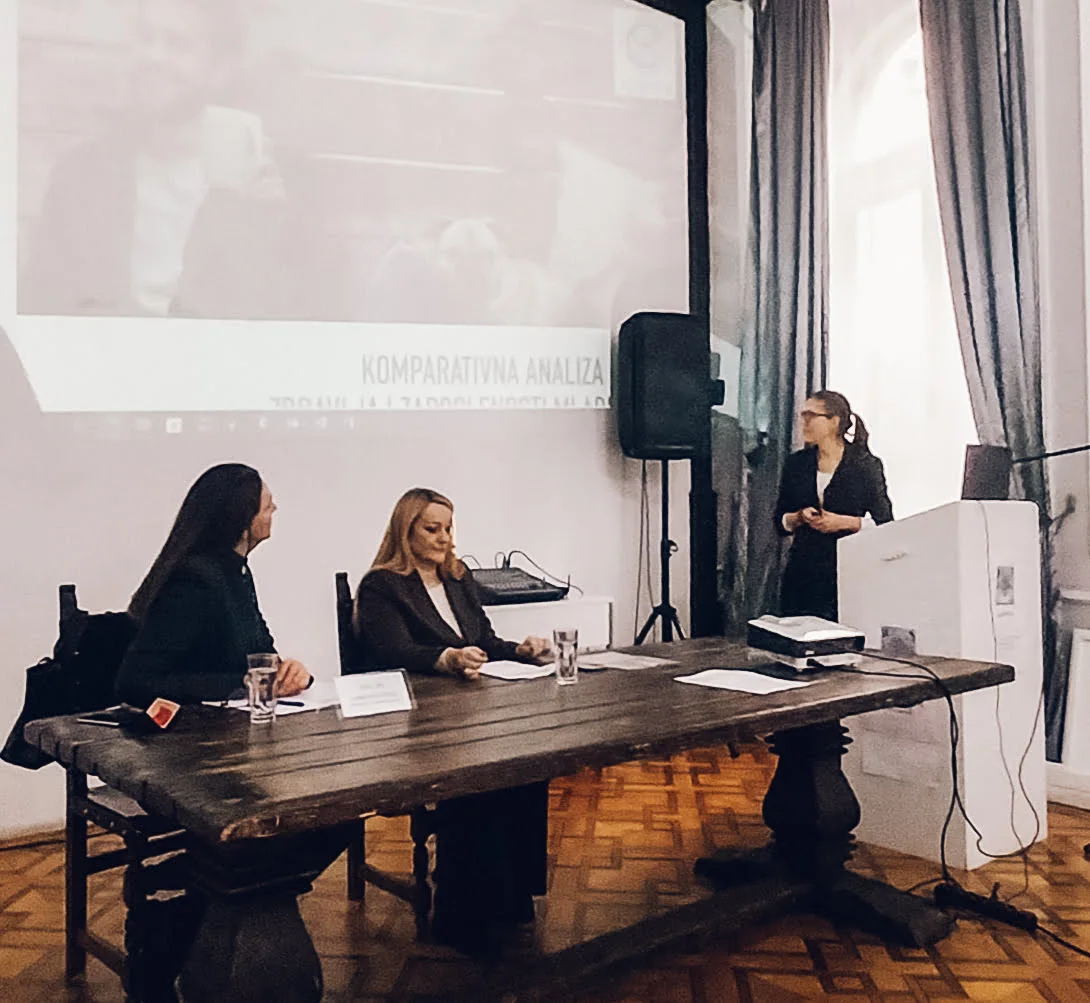
At the international ALOPPS 2025 conference, held on November 28 in Belgrade, professors of the Faculty of Organizational Studies “Eduka” presented the results of two contemporary studies that connect key social topics—the position of young people in Serbia and the psychological mechanisms that influence subjective well-being. The participation of our professors attracted great interest from both the professional and academic public, confirming the growing reputation of FOS “Eduka” as a faculty that actively contributes to relevant scientific discussions.
The first paper, “Comparative Analysis of Young People’s Perception of Health and Employment in Serbia and the European Union,” was presented by Assistant Professor Dr. Dragana Mitrić-Aćimović, co-authored with Dr. Nataša Papić Blagojević, Prof. Dr. Ivana Josanov-Vrgović, Prof. Dr. Đerđi Erđeš-Kavečan, and Assistant Professor Dr. Bojana Grahovac.
Analyzing the period from 2015 to 2024, the authors presented clear differences in the labor market position of young people in Serbia compared to the European Union. Particular emphasis was placed on gender differences and the uniquely challenging position of women aged 20–24. The results indicate the need for targeted policies that would improve youth employability and contribute to their better social and health status, especially in the post-pandemic period.
The second paper, “Correlations Between Rigidity and Positive Affectivity,” was presented by Assistant Professor Dr. Bojana Grahovac in collaboration with Assistant Professor Dr. Dragana Mitrić-Aćimović, Prof. Dr. Đerđi Erđeš-Kavečan, and Prof. Dr. Ivana Josanov-Vrgović.
The research focuses on psychological rigidity—a construct traditionally viewed as negative. However, the results of our team reveal a more nuanced picture: certain forms of rigidity may positively contribute to subjective well-being by encouraging stability, organization, and emotional alignment. These insights open new doors for the development of more precise psychological interventions in practice.
Through the presentation of these two papers, the professors of FOS “Eduka” confirmed that our faculty actively participates in shaping contemporary scientific currents relevant to youth, organizations, and psychological practice. We are proud that our researchers contribute to understanding current social issues and psychological processes, laying the groundwork for better policies, better practice, and a better society.
FOS “Eduka” continues to unite science, innovation, and social responsibility—for the benefit of students, the community, and the professional public.