



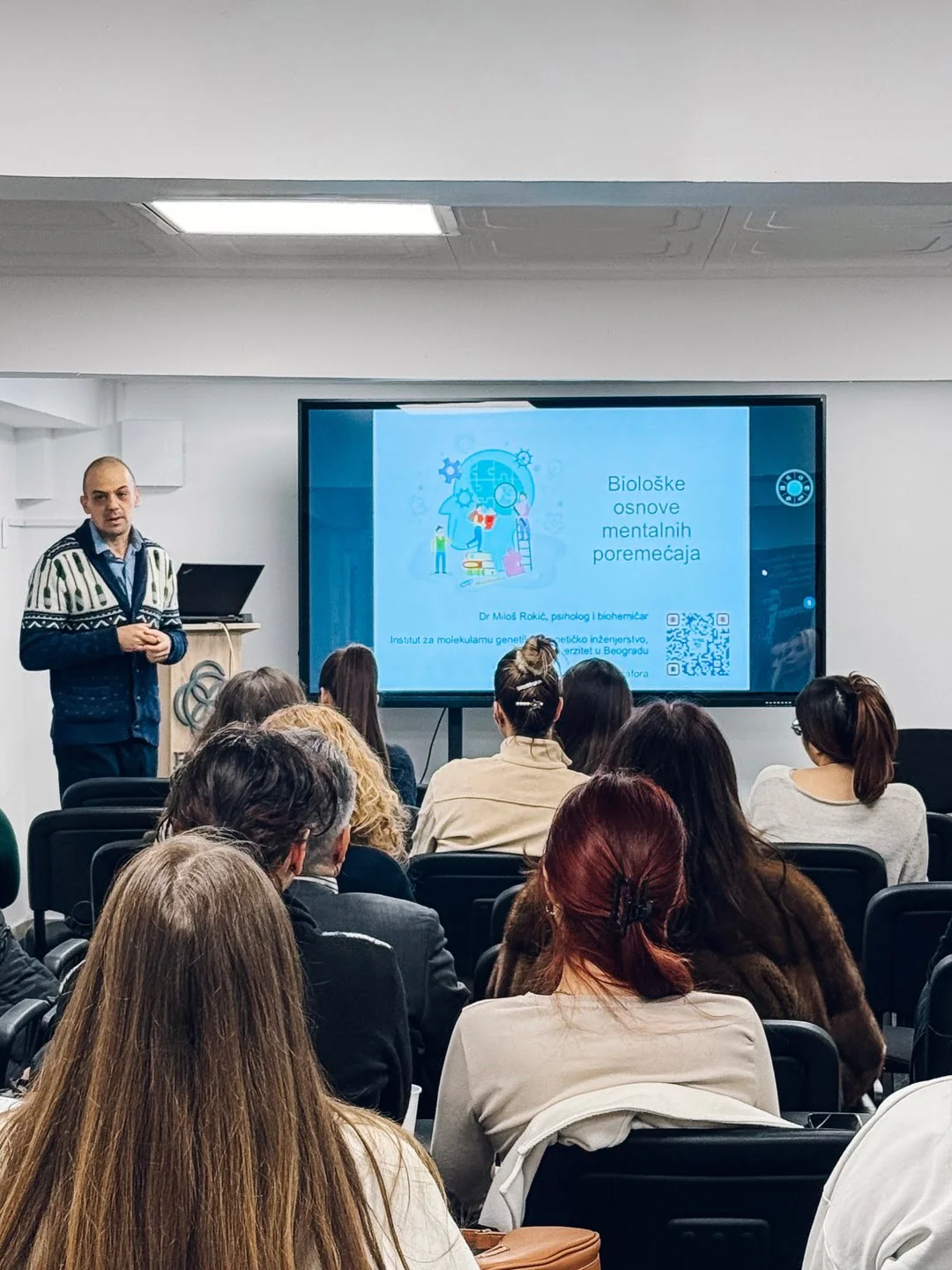
At the Faculty of Organizational Studies “Eduka,” within the course Biological Psychology at the undergraduate level, a highly professional lecture titled “Biological Foundations of Mental Disorders” was held, bringing together students, teachers, and a wider audience interested in contemporary scientific insights into human behavior and mental health. The lecture was delivered by Dr. Miloš Rokić, a graduate biochemist and PhD in physiology and neuroscience, psychologist, and psychotherapist in supervision, whose multidisciplinary approach combines biology, psychology, and therapeutic practice.
The lecture opened with an intriguing question: do mental disorders originate in the genes or in the mind, and where is the boundary between biological and psychological causes of behavior? In the introductory part, the audience was introduced to modern concepts that view mental disorders through the interaction of genetics, neurobiology, and psychological processes. Special focus was placed on the molecular mechanisms of the brain, neural networks, and gene variations that shape emotions, cognition, and behavior patterns.
Dr. Rokić highlighted his research in the field of P2X ion channels expressed in the brain, with more than 11 international publications and over 20 conference presentations, as well as his work in neuroendocrinology, particularly the pituitary gland. His teaching experience includes mentoring a master’s student in Prague and a doctoral candidate at the Institute of Molecular Genetics and Genetic Engineering.
The lecture covered an analysis of clinically significant disorders, illustrated with authentic examples from practice, including autism, ADHD, obsessive-compulsive disorder, bipolar disorder, and forms of dementia. Special emphasis was placed on biological markers and mechanisms linking neurotransmitters, gene variations, and the structure of the nervous system with clinical symptoms.
The central part of the lecture examined the complex relationship between the biological and the psychogenic, highlighting the interplay of genetics, experience, and environment. The final segment was dedicated to contemporary knowledge on genetic determinism, the inheritance of mental states, and brain neuroplasticity, with the message that the brain remains dynamic and changeable throughout life, influenced by experiences, therapy, and the social environment.
In addition to his scientific research, Dr. Rokić actively works in psychological practice, including the project “Prevention and Eradication of Chronic Wounds in Individuals with Diabetes,” funded by the Ministry of Science, Technological Development and Innovation, as well as providing therapeutic support in private practice at two locations in Belgrade. His community work includes group counseling within the Multiple Sclerosis Society of Serbia, the Youth Center (CEZAM), and the National Organization of Persons with Disabilities.
This lecture opened important questions about the multidisciplinary understanding of mental health and encouraged the audience to reflect on the complex interactions between genetics, the brain, and psychological development. The Faculty of Organizational Studies “Eduka” thanks Dr. Rokić and everyone who attended and participated in the discussion, emphasizing the importance of a modern, holistic approach to mental health.