



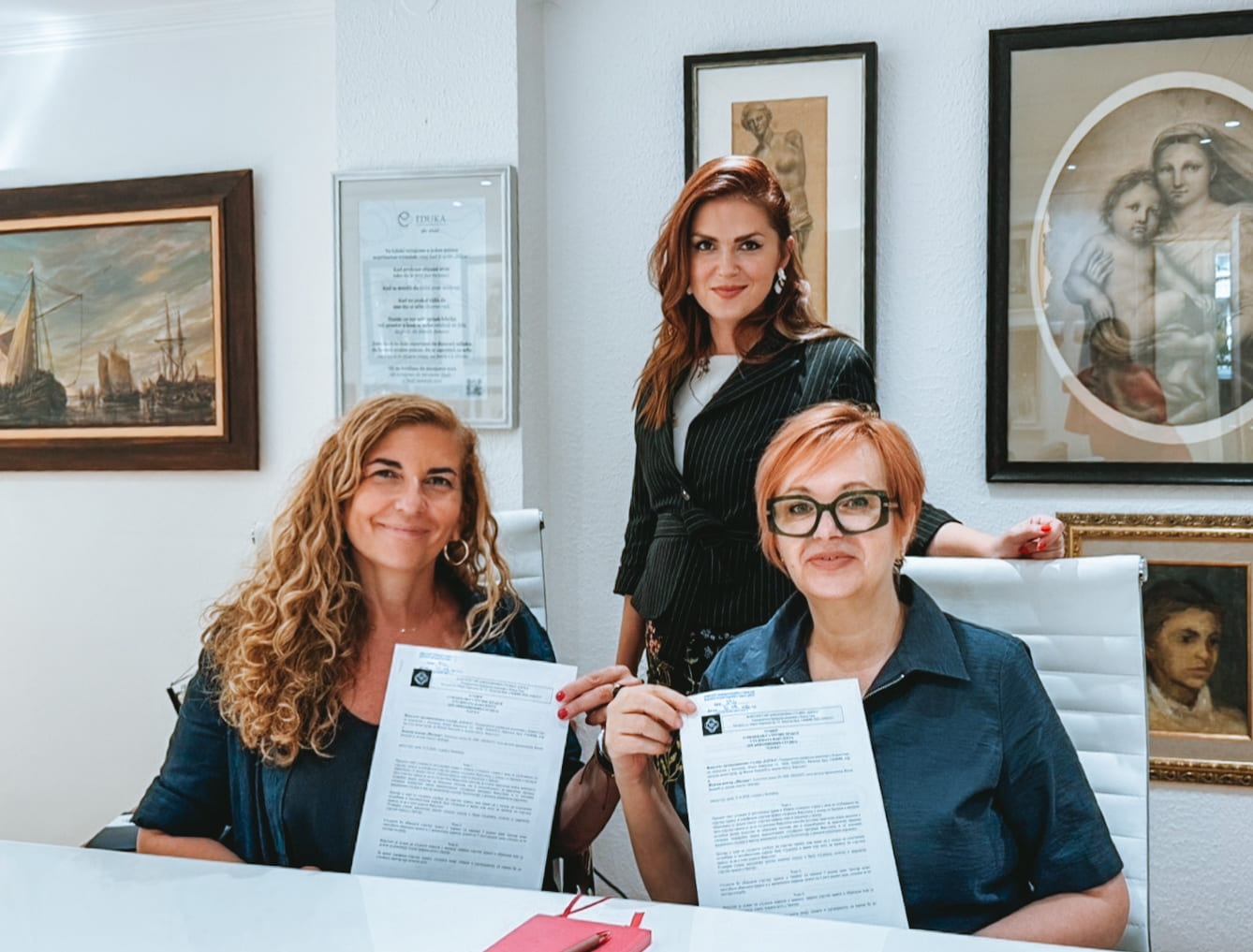
Today, the Faculty of Organizational Studies “Eduka” signed a cooperation agreement with the Women’s Center “Milica”, an organization that provides support to women diagnosed with breast cancer.
The signing of the agreement marks the beginning of a cooperation aimed at connecting academic knowledge with direct practice, with a particular focus on the field of psycho-oncology. As part of the cooperation, Psychology students of the Faculty “Eduka” will have the opportunity to undertake professional practice at the Women’s Center “Milica”, learn about the specific aspects of psychological support for women diagnosed with breast cancer, and develop knowledge and skills relevant to their future professional work.
The aim of the Faculty is to contribute, through such partnerships, to the development of future psychologists’ competencies, as well as to strengthening psychological support for people affected by cancer as one of the leading public health challenges of modern society.
The President of the Faculty of Organizational Studies “Eduka”, Jelena Đorđević Boljanović, emphasized that it is extremely important for Psychology students to have the opportunity to apply the knowledge they acquire during their studies in a real-world environment and, with the support of professionals, develop their competencies.
The President of the Women’s Center “Milica”, Vesna Bondžić, stated:
“Sixteen years of experience working with oncology patients and members of their families has taught us to recognize their real needs and provide support where the greatest challenges arise. Cooperation with the Faculty “Eduka” represents an opportunity to connect this experience with the knowledge students acquire during their studies and to jointly contribute to the development of higher-quality support for people affected by cancer.”
The cooperation between the Faculty “Eduka” and the Women’s Center “Milica” represents another step toward connecting higher education with practice and the needs of society. “Eduka” continues to provide its students with opportunities for experiential learning, professional development, and direct engagement with the community, believing that this is how we create not only more competent professionals, but also a better and more humane society.